

UNDERSTANDING THE POWER OF VALUES AND BELIEFS
- shoury01
- Nov 2, 2021
- 5 min read
Updated: Jun 11, 2025

Discover how values and beliefs shape our daily decisions and behavior, and learn to decode what truly drives people—with real-world insights and practical tools.
Why We Do What We Do
Ever wondered why we make certain decisions—why we vote for a leader, support a brand, or react to a crisis the way we do? Much like the patterns on a cricket pitch shaped by the mower’s direction, our behaviors are shaped—quietly but powerfully—by the direction of our values and beliefs.
The Invisible Forces Guiding Us
We are a nation of cricket lovers. The feature that we hit upon straightaway when visiting a cricket stadium for the first time is the grass. Pruned to perfection, it exhibits stripes, diamonds, a checkerboard, or even arches.
Over the years we may have gathered many theories about how they are created: the grass is colored, has different lengths, and so on. But the real reason is a lot more naive. It’s the direction of the blades that tints the grass in various shades. When the sun hits an upright blade, its whole frame reflects the light–rendering it brighter than a blade that points directly towards the sun. Most professionals create the patterns by mowing in different directions. But the astute among them have another trick up their sleeve: they use a simple roller behind their mower to direct the blades with even more force.
And the same way the mowing and rolling directs the grass, our values and beliefs direct our behavior as humans. It is directed by internal patterns—the value-belief-attitude chain. Just like the groundskeeper uses a roller to shape the field, our values subtly but steadily guide what we say and do.
What Influences Our Behavior?
On the surface, most of our human behaviors do not seem rational. But if we follow these impulses down to their roots, everything starts to make sense.

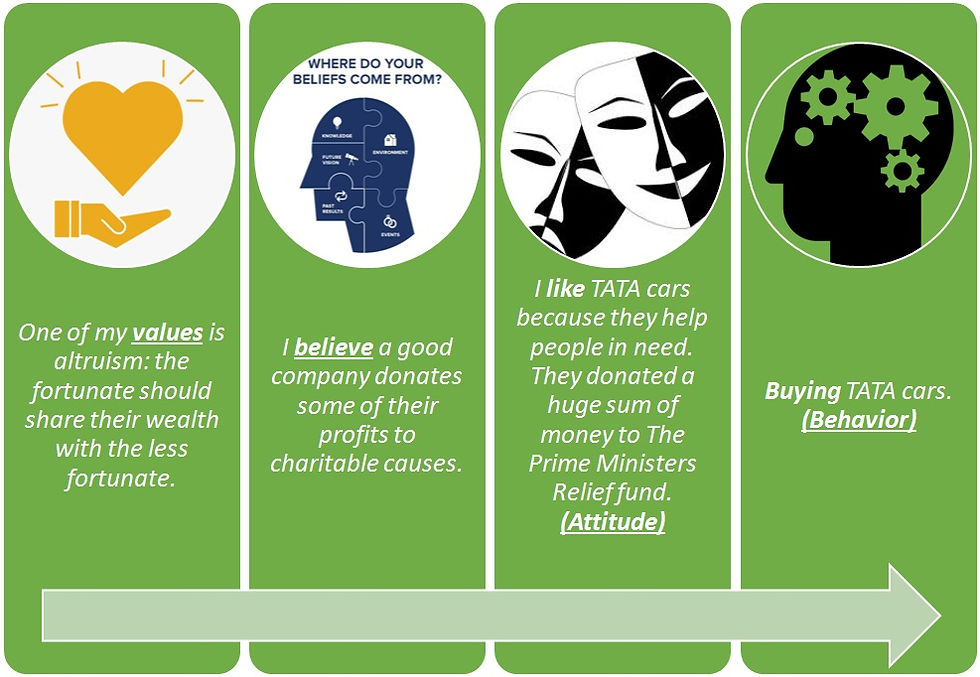
It’s called the Value-Behavior Chain. Our Values influence our beliefs, which determine our attitudes that guide our behavior. That means if a business wants to influence its customers behavior, it must change their attitudes, beliefs or values first.
Values
Values are a measure of worth we attach to something. We can value something very little–meaning basically do not care. Or we can value someone a lot–going out of our way to do something for that person. Going even further, values often guide us between what is good and what is bad. Universal values are - for example- happiness, love, freedom, respect, equality and justice. But they can also be as specific as this:
One of my values is altruism: the fortunate should share their wealth with the less fortunate.
Case-In-Point: In 2022, Patagonia’s founder, Yvon Chouinard, transferred the company’s ownership to a trust to fight climate change. That act wasn’t about branding—it was about living a core value: environmental stewardship.
Reflection: What’s one core value that has consistently shaped your major life decisions?
Beliefs
A belief is a feeling that something is true. As a whole, our beliefs represent all the bits of information we collect about people, events and things in life. They do not necessarily have to be rational or based on facts. They can even be false beliefs and we still cling on to them. They grow stronger the longer we keep them and the more we keep repeating them to ourselves or others. Following our example chain, this could be a belief that is based on the value above:
I believe a good company donates some of their profits to charitable causes.
Case-In-Point: A belief might be “Businesses should give back to society.” Infosys co-founder Narayana Murthy embodies this belief through persistent philanthropy and CSR investment.
Try this: Write down three beliefs you hold about work, family, or society. Now ask: Where did these come from?
Attitudes
Our attitudes are based on our values (good and bad) and our beliefs (what we know). And they express our relationship towards the world around us. Based on what we value and believe, we like something or dislike it. Or we are ambivalent. An example of an attitude in our chain might be:
I like TATA cars because they help people in need. They donated a huge sum of money to The Prime Ministers’ Relief fund.
Case-In-Point: Many people admire Tata Group not just for its cars or hotels, but because of its consistent support for communities in need—especially during the COVID-19 crisis. That admiration is an attitude, built on a belief in social responsibility.
Behavior
Our behavior is simply what we do and say–our words and actions. Based on the attitude above, the chain would be concluded through the following behavior:
I Buy TATA Cars.
Case-In-Point: Choosing to buy from a brand like Body Shop or Forest Essentials often stems from valuing sustainability, believing in ethical sourcing, and feeling positively toward eco-conscious companies.
Visualizing the Connection
Imagine a buoy anchored to the ocean floor. The buoy (our attitude) rises and falls with the tide (life’s circumstances), but it remains tied to the anchor (our values) via a chain (our beliefs). Behavior, in this metaphor, is the ship that sails in response to these markers.

Our attitudes are like buoys. Like the ground, our values will rarely change. Depending on the tide–the circumstances in our life-the buoy will go up and down.
Meaning our attitudes will adapt to what’s happening to us. But they will always depend on our beliefs, as these can be stretched only so far before they break. The only missing piece in the picture is our behavior. Not hard to guess, they are the ships which are guided by the buoys.

As soon as we dive below the surface, people are a lot more rational than they often seem. In fact, their behavior becomes quite clear when we take their motives into account:

And once we know their motives, getting them along becomes as easy as creating a perfectly shaped checkerboard on a cricket field.
Why This Matters
Whether we’re shaping classroom culture, guiding a team, parenting, or building a business, understanding the value-belief-behavior chain helps us align better with others—and with ourselves. When we notice what truly drives people, we can build trust, shift attitudes, and inspire action with clarity.
In leadership, brands like Microsoft under Satya Nadella or social movements like the MeToo resurgence in India show how aligned values and consistent behavior foster real transformation.
Final Thoughts
Values and beliefs aren’t abstract ideas—they’re the invisible rollers that direct the “blades” of our daily actions. When we trace behaviors back to their source, the world—and its people—start to make much more sense.
Content Curated By: Dr Shoury Kuttappa


Comments