

SYSTEMS THINKING IN ORGANIZATIONAL DEVELOPMENT: NAVIGATING COMPLEXITY CHANGE, AND PERFORMANCE
- shoury01
- Dec 23, 2025
- 6 min read
Explore how systems thinking in organizational development helps us navigate complexity, align purpose, and lead change by understanding interconnections across people, processes, and outcomes.

Most organizational failures do not stem from a lack of talent, effort, or intent. They emerge because well-meaning leaders attempt to solve complex problems with linear solutions—treating symptoms while the system quietly resists, adapts, or breaks elsewhere.
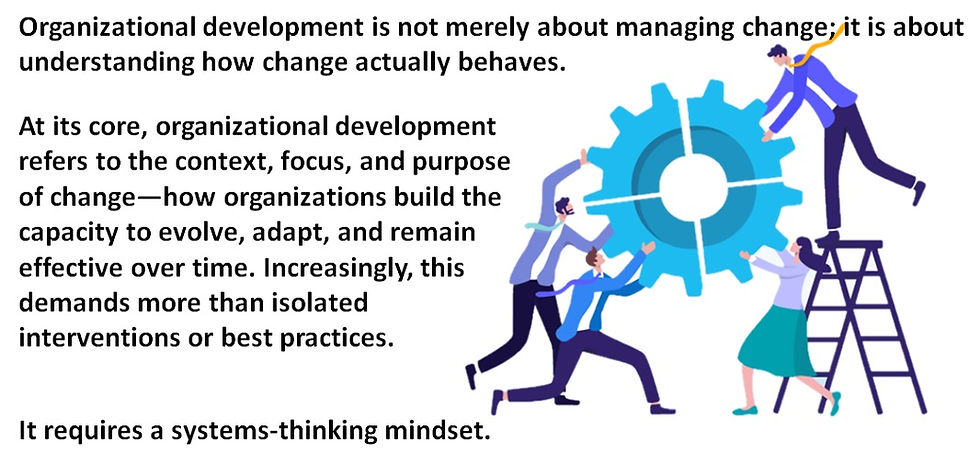
Systems thinking offers a way to see organizations not as collections of independent parts, but as living, interconnected systems shaped by relationships, feedback loops, and purpose. As one contemporary definition succinctly puts it, “Systems thinking is, literally, a system of thinking about systems.” This perspective shifts leaders from asking “What went wrong?” to “What is this system designed to produce?”
In an era of accelerating complexity, competing priorities, and unintended consequences, systems thinking is no longer a theoretical luxury. It is a practical discipline—essential for leaders seeking to design organizations that learn, adapt, and sustain performance rather than merely react to change.

Analytical/ Linear Thinking Vs Systems Thinking

The Parts Of A System
Systems are made up of three parts: elements, interconnections, and a function or a purpose. The word “function” is used when talking about a non-human system, and the word “purpose” is used for human systems. The elements are the actors in the system. In our circulatory system, the elements are our heart, lungs, blood, blood vessels, arteries, and veins. They do the work. The interconnections would be the physical flow of blood, oxygen, and other vital nutrients through our body. The function of the circulatory system is to allow blood, oxygen and other gases, nutrients, and hormones to flow through the body to reach all of our cells.
An Example – The School (or) An Educational Institution
A school is a system, with the elements represented by teachers, students, principals, custodians, secretaries, bus drivers, cooks, parents, and counsellors. The interconnections are the relationships between the elements, the school rules, the schedule, and the communications between all of the people in the school. The purpose of a school is to prepare the students for a successful future and to help them reach their full potential.
Unfortunately, some unintended behaviors can occur as a result of Organizational Change when the Systemic interplay is ignored. Consider the purposes of the actors in this system:

In this system, the high-stakes nature of the tests cause school districts to put a lot of pressure on their teachers to teach to the test and base their evaluations on their test scores. Teachers feel the need to compete with one another to earn the highest scores, as well as gain job security and an increased salary, so they no longer share ideas with one another and they may even cheat when administering the tests. Students feel a lot of pressure to earn high enough scores to be promoted to the next grade or avoid remedial classes, so they may cheat on the test.
A government may profess that educating children is a high priority, but if it slashes education funding, then clearly educating children is not a primary purpose of that government. This was not the intention of putting these tests into schools, and everyone agrees that those results are awful. Unfortunately, if the sub-purposes and the overarching system purpose are not aligned and coexisting peacefully, a system can’t function successfully.
The Most Important Part of a System
Perhaps the easiest way to examine how a system’s elements, interconnections, and purposes compare in terms of importance within a system is to speculate how the system would be impacted if each component was changed one at a time.
The least impact on a system is usually felt when its elements are changed. While certain elements may be very important to the system, by and large, if the elements are changed, the system can still continue to exist in a similar form and work to achieve its purpose or function. In a school, teachers, administrators, and other employees may leave, transfer, or retire. Students move away or may enter higher grade levels beyond the school. The elements may change, but the school is still easily identified as a school, and it still has largely the same objectives and sense of purpose.
Changing the interconnections of a system is quite different. If the interconnections change, the system will be impacted significantly. It may no longer be recognizable, even if the elements remain in place. Putting the students in charge instead of the adults in a school setting would undoubtedly change that system dramatically.
Changing a system’s function or purpose also greatly impacts the entire system and may render it unrecognizable. If the school’s main purpose is no longer educating children, but is now to make money by recruiting students to charge tuition, obviously the system is dramatically changed.
Every component of the system is essential. Elements, interconnections, and the purpose or function all interact with each other and each one plays a vital role in the system. The purpose or function of a system is often the least noticeable, but it definitely sets how the system will behave. Interconnections are the relationships within the system. When they are changed, the behavior of the system is also usually altered. The elements are typically the most visible parts of a system, but are often the least likely to cause a significant change in the system unless changing an element impacts the purpose or interconnections as well. Each part of the system is equally important as they work hand in hand, but changing a system’s purpose has the greatest impact on the system as a whole.
Leadership Insight Box: What the School System Teaches Leaders
The failure in the school example is not a failure of individuals—it is a failure of system design. When performance metrics (test scores) become more important than the system’s true purpose (learning and development), behavior predictably distorts. Teachers stop collaborating, students focus on outcomes over understanding, and unethical shortcuts emerge—not because people are unethical, but because the system quietly rewards the wrong behavior.

Effective leadership in complex systems is less about enforcing compliance and more about aligning purpose, incentives, and feedback loops. When these elements reinforce one another, ethical behavior, learning, and performance emerge naturally. When they don’t, dysfunction becomes inevitable—regardless of talent or intent. Systems don’t misbehave. They do exactly what they are designed to do.
Six Themes Of Systems Thinking

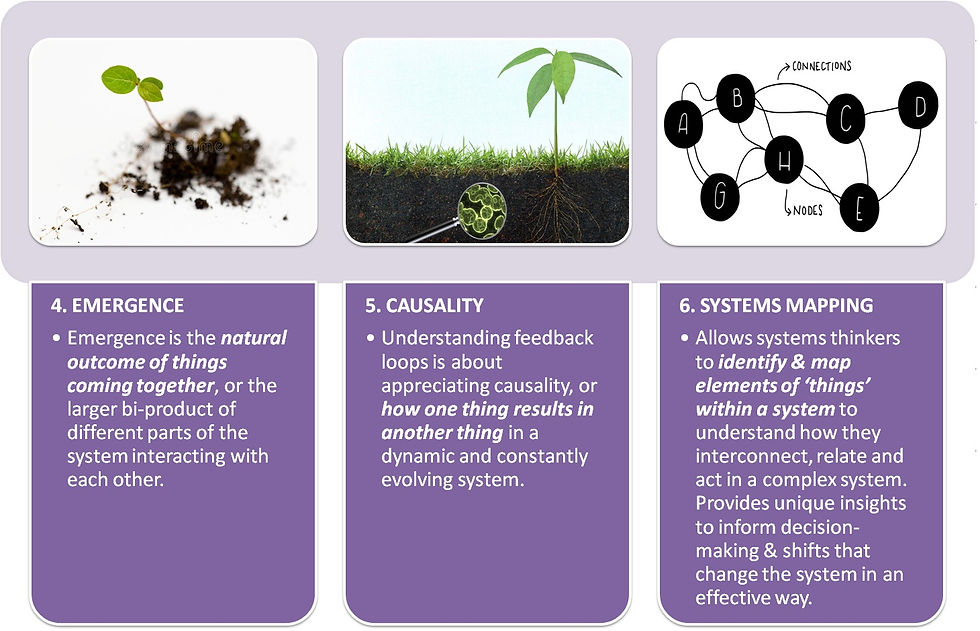
Interconnectedness and synthesis relate to the dynamic relationships between various parts of a whole, the process of obtaining expected synergies between parts of the company. This includes the idea of circularity, which stresses the requirement of a mindset shift from linear to circular. Similarly, the concept of emergence relates to the outcomes of synergies that can come about as the elements of a system interact with each other in nonlinear ways. In the workplace, this often takes the form of the push and pull that happens due to organizational politics and competing priorities. Organizational leaders with a systems-thinking mindset will see this as an opportunity for enhanced collaborations and innovation.

Balancing and reinforcing feedback loops within an organization serve as guidance for making adjustments as we learn more about the interconnectedness of the elements of the system and their outcomes. Additionally, causality refers to the flows of influence between the many interconnected parts within a system. As we better understand the casualty and directionality of these elements, we will have an improved perspective on the many fundamental parts of the system, including relationships and feedback loops.
In the workplace, a skilled systems-thinking leader will ensure that mechanisms for multiple feedback loops are established and effectively communicated to their employees. Furthermore, they will understand correlation versus causation as they use the data gathered from the feedback loops to enhance workplace practices. Finally, systems mapping is a tool that systems thinkers can use to identify and visually map out the many interrelated elements of a complex system, which will help them develop interventions, shifts, or policy decisions that will dramatically change the system in the most effective way.
Ten Enemies of Systems Thinking
Organizations are perfectly designed to produce the results they get. When outcomes disappoint, the instinct is often to replace people, restructure teams, or introduce new initiatives. Yet systems thinking reveals a deeper truth: lasting change rarely comes from altering visible elements alone. It comes from understanding—and deliberately redesigning—the interconnections and purposes that quietly govern behavior. Some common thinking statements which act as obstacles to systems thinking may be:

The greatest value of systems thinking lies not in prediction, but in perception. It enables leaders to see patterns instead of events, relationships instead of silos, and long-term consequences instead of short-term fixes. In doing so, it expands an organization’s capacity to respond intelligently to complexity rather than be overwhelmed by it.
As environments grow more volatile and interdependent, the ability to think systemically becomes a strategic advantage. It allows organizations to fine-tune themselves in real time, align intent with outcomes, and pursue sustainability not as a slogan, but as a systemic capability.
Ultimately, systems thinking reframes leadership itself—from controlling outcomes to shaping conditions, from managing parts to stewarding the whole. In a world where linear answers increasingly fail, it is this shift in thinking that determines whether organizations merely survive change—or learn to thrive within it.

Content Curated By: Dr Shoury Kuttappa.




Comments