

SCARCITY MINDSET EXPLAINED: SIGNS, PSYCHOLOGY, AND HOW TO OVERCOME IT - (CHAPTER 02)
- shoury01
- Apr 9
- 6 min read
***Continued from Chapter 01 (Covered previously: Meaning, How Scarcity Hijacks the Brain, Why Scarcity Feels So Powerful impact, Loss Aversion, The Psychological Roots of Scarcity)
Link to Chapter 01:
How Scarcity Mindset Quietly Shows Up in Everyday Life
Scarcity mindset does not always look dramatic. Often, it shows up in small habits, recurring thoughts, emotional reactions, and unconscious behaviours that quietly shape how we live, choose, relate, and respond. The more we operate from a sense of “not enough,” the more likely we are to see life through fear, limitation, comparison, urgency, and self-protection. Here are some of the most common ways it tends to manifest:
A) We Start Believing Our Situation Is Permanent
One of the first signs of scarcity mindset is the belief that things will always remain this way. We begin to think:
o “This is just my life.”
o “Things never change for me.”
o “This is how it will always be.”
This kind of thinking drains hope, motivation, resilience, and self-belief. It traps us in a fixed emotional reality and makes change feel less possible than it actually is.
An abundance-oriented mindset, by contrast, sees life as dynamic, flexible, and still open to influence. It does not deny difficulty—but it refuses to treat the present moment as a permanent sentence.
B) We Speak the Language of Lack
Scarcity often begins in the mind, but it quickly starts showing up in our self-talk, assumptions, and inner narrative. Phrases like:
o “There’s no point.”
o “I’ll probably get rejected.”
o “There’s never enough.”
o “Other people have the advantage.”
o “It’s too late for me.”
These thoughts may feel realistic, but repeated often enough, they begin to shape our identity and behaviour. This is where self-awareness becomes essential. Not every negative thought deserves belief. Many are simply fear speaking in the voice of certainty.
C) We Compare Ourselves Into Misery
Scarcity mindset thrives on comparison. Instead of focusing on our own path, we become preoccupied with what others have:
o their success
o their income
o their lifestyle
o their relationships
o their opportunities
o their confidence
The more we compare, the less we notice what is already available in our own life.
Comparison erodes gratitude, emotional stability, and self-worth. It convinces us that someone else’s gain is automatically our loss—which is one of the clearest psychological signs of a scarcity mentality.

D) We Become Less Generous
When we live in fear of not having enough, we often start withholding—not just money, but time, warmth, attention, trust, encouragement, kindness, and emotional availability.
Scarcity mindset makes people “skim off the top” of life. They give less, protect more, and hold back instinctively.
But generosity is not only about resources. It is also about presence, goodwill, openness, and contribution. A scarcity mindset shrinks those qualities. An abundance mindset expands them.
E) We Chase Quick Relief Instead of Real Fulfillment
Scarcity often drives us toward instant gratification. When we feel deprived—emotionally, mentally, financially, or relationally—we become more vulnerable to behaviours that offer fast comfort but little long-term value. This can look like:

These behaviours are not random. They are often attempts to soothe the discomfort of feeling “not enough.” The problem is that quick relief rarely creates real stability. It usually deepens the cycle.

F) We See Life as a Competition for Limited Space
Scarcity mindset often turns other people into threats instead of peers.

This can create unnecessary defensiveness, envy, territorial behaviour, and isolation.
But in many areas of life and work, growth comes less from competition and more from collaboration, visibility, creativity, adaptability, and contribution. Scarcity forgets this. Abundance remembers it.
G) We Use External Conditions as Permanent Internal Limits
A scarcity mindset often turns real-world difficulty into a total psychological identity. We begin to think:
o “The economy is bad, so nothing is possible.”
o “Resources are limited, so I shouldn’t even try.”
o “Other people can succeed, but not me.”
Of course, external conditions matter. But scarcity mindset tends to overextend them into a full worldview. Some of the most resourceful and resilient people do not wait for perfect conditions. They learn to spot possibility inside constraint.

Scarcity mindset does not always announce itself loudly. Sometimes, it simply shows up as the quiet belief that there is not enough life, not enough room, not enough love, not enough time, or not enough of us. And if we do not question that belief, we begin to build our choices around it.
Scarcity And Abundance Loops at Play (Using an example of Art)

Scarcity Mindset at Play: How It Quietly Influences Our Decisions
Scarcity is not always loud. Often, it works in subtle, highly strategic ways — shaping our attention, urgency, emotions, and judgment without us even realizing it. In daily life, brands, institutions, platforms, and even relationships often trigger scarcity cues to influence our behavior.

Why does this work so well? Because the human brain is wired to treat limited access, disappearing opportunities, social competition, and exclusivity as signals of importance. When something feels rare, restricted, or about to vanish, we instinctively assign it more value. The result: we stop evaluating clearly and start reacting emotionally. Below are some of the most common ways scarcity shows up around us:
A) Time-Limited Scarcity: “Act Now or Miss Out”
This is one of the most common and powerful scarcity triggers. When access to something is available only for a short period, it creates urgency and compresses decision-making. Instead of asking, “Do I really want this?” the brain shifts to, “Will I lose this if I wait?”
This often leads to impulsive decisions, rushed judgment, and action driven more by pressure than by clarity. Common examples:
o E-commerce flash sales with countdown timers
o “Offer ends tonight” promotions
o Airline or hotel booking deadlines
o Last-minute exam preparation or project completion
A countdown timer on a shopping platform is not just informational — it is psychological. It signals that delay equals loss, and that perception alone can override rational thinking.
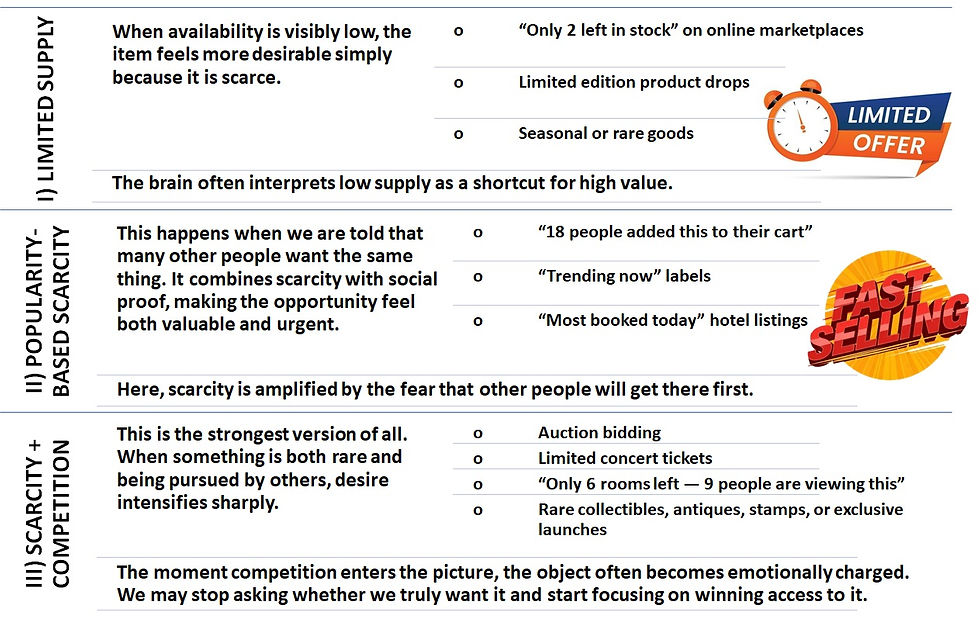
B) Quantity-Limited Scarcity: “Only a Few Left”
When something appears to be running out, it instantly feels more valuable. This is because scarcity activates both loss aversion and competitive desire. We do not just want the item — we want to avoid being the person who missed it. This form of scarcity is often even more powerful than time pressure because it feels less predictable and more socially charged. It usually appears in three forms:
C) Access-Limited Scarcity: “Not Everyone Gets In”
Sometimes scarcity is not about time or quantity — it is about permission. When access is restricted, people often perceive the thing as more prestigious, desirable, or important. Exclusivity creates a powerful psychological signal: If fewer people can have it, it must mean more. This form of scarcity often taps directly into status, identity, and belonging. Examples:
o Invite-only product launches
o Premium memberships and VIP access
o Private communities or gated groups
o Early access or waitlist-based platforms
When access itself becomes scarce, the experience begins to feel like a marker of social significance rather than simple utility.
D) Restriction, Ban, or Censorship: “Now I Want It More”
One of the most fascinating aspects of human behavior is this: the moment freedom feels restricted, desire often intensifies. This is the core of psychological reactance — when people feel that a choice, person, product, or idea is being blocked, they often want it more than before. Examples:
o Content that gets banned or restricted suddenly attracting more attention
o Strict parental disapproval intensifying romantic attraction
o “Unavailable” products suddenly feeling more desirable
o Social or institutional rules increasing emotional fixation
This is why prohibition often creates obsession. What was once ordinary can become deeply compelling the moment it feels forbidden, inaccessible, or threatened.
E) One-of-a-Kind or “Now or Never” Experiences
Some scarcity cues are tied not to products, but to moments. These are experiences framed as rare, unrepeatable, or once-in-a-lifetime. Because they cannot easily be recreated, they carry emotional weight. Humans are naturally drawn to moments that feel historic, sacred, exclusive, or fleeting. Examples:
o Limited-time launch events
o One-time religious or cultural gatherings
o Rare performances, exhibitions, or public appearances
o Introductory offers available only at launch
These experiences are powerful because they do not just trigger FOMO — they trigger a deeper fear: the fear of never being able to come back to this moment again.
Ways to deal with Scarcity Mindset
A scarcity mindset does not disappear through “positive thinking.” It shifts when we change how we interpret limits, regulate emotions, and make decisions. The goal is not to deny constraints, but to stop letting them dictate our behaviour.

Closing Insight
Scarcity is real—but so is our ability to respond to it with greater self-awareness, perspective, and emotional intelligence. The real danger is not always having less. It is allowing “not enough” to become the lens through which we see everything.
Because the opposite of scarcity is not excess.
It is enoughness, clarity, and the courage to stop clutching at life.

Content Curated By: Dr Shoury Kuttappa.


Comments